
Revitalizing the Rock Island Bridge: A Conversation with Mike Zeller
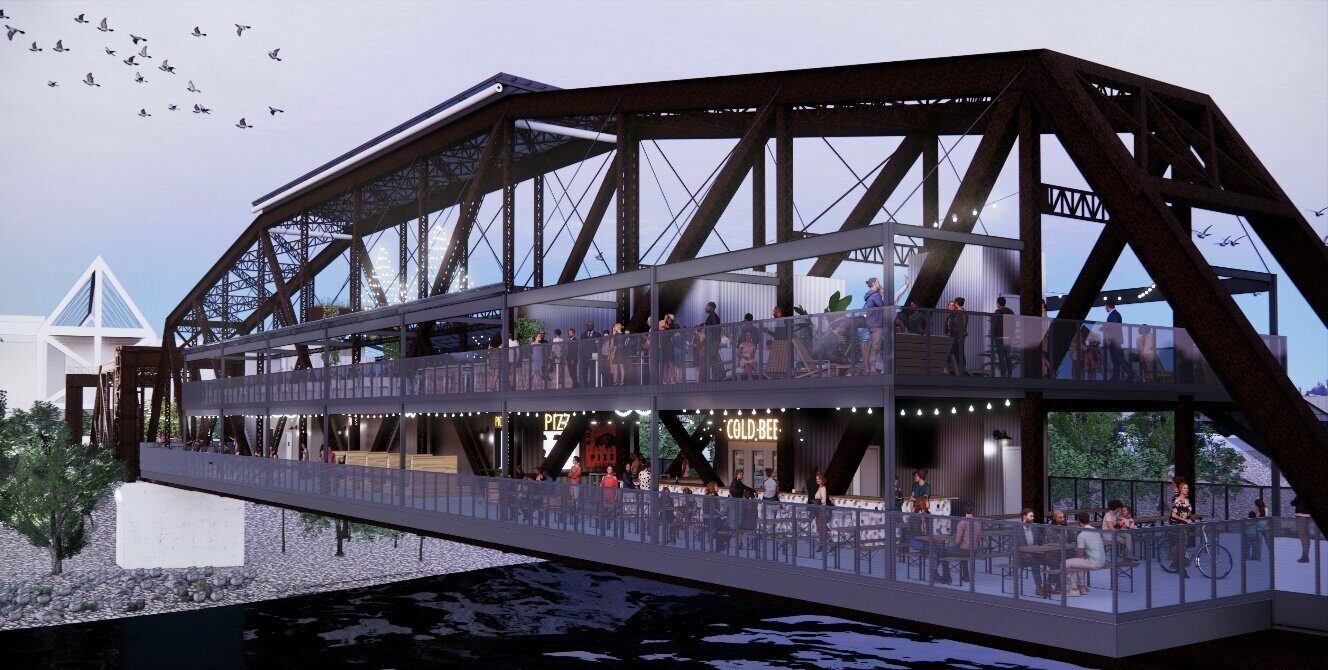
Kansas City will soon be home to America’s first destination bridge. A mix of public, private and philanthropic partners are joining together to restore the historic Rock Island Bridge and create an entertainment district and trail crossing over the Kansas River. Mike Zeller, one of the innovators behind the project, shares details and updates about the Rock Island Bridge developments with Senior Philanthropic Advisor Whitney Hosty.
Below you’ll find the conversation.
Interview Highlights
The following exchange has been edited for length and clarity.
Whitney Hosty: To start, could you please tell us a little bit about the history of the area and what it looks like today?
Mike Zeller: This is the Rock Island railroad bridge over the Kansas River and it’s in the West Bottoms. The Kansas River comes in out of Western Kansas. It flows through Lawrence, and it swings around and almost touches Missouri before heading north about the final mile and a half where it joins the Missouri River at Kaw Point.
The general term for that valley down there is the West Bottoms. It was really the first industrial area of the city. At the turn of the century, I’ve read in many different places that about 80% of the economy was in the West Bottoms. There’s a lot of great old brick and ancient growth, timbered warehouses, six, eight stories tall down there famous for the haunted houses, but all that’s in transition right now. As like so many other historical areas of our cities across the country, it’s becoming more residential and there’s several developments underway. There’s the Flats to the north by the Missouri River, which is about six or eight big 1890s warehouses, all being converted mostly to residential. There’s the Stockyards further to the south, which is the subset of the West Bottoms where the bridge is located. That’s right next to what used to be Kemper Arena, that’s been converted. A second floor is suspended between the roof and the bottom floor, so they have equivalent of 16 basketball courts of space. The stockyards are gone, but the Livestock Exchange building of course is going great. The Rock Island Bridge is right there next to it. It was integral to the stockyards as they were. Of course, they’ve been gone for 30 years now, and that whole area is in the process of reinvention.
Whitney Hosty: Excellent. It sounds like there’s a lot happening in the area. Can you tell us a little bit more about the neighborhoods? Especially as we look across the bridge into Kansas, can you tell us about the neighborhoods there and how community investment plays a role in the development of this project?
Mike Zeller: Sure. Both sides of the bridge are in Kansas. We’re close to Missouri. This is Kansas Bridge, and it really connects the Stockyards Districts in Missouri to Armourdale, which is where a lot of the workers in that industry lived. And still a lot of people who continue to live in Armourdale. It’s a very charming little community over there. That is really the origin of our project. My partners, John McGurk and Mike Laddin and I had leased that bridge with the intention of creating a simple event space in the center. When a fellow working on a healthy Wyandotte grant, Rick Barons came to us as an agent of the Unified Government of KCK, and said, hey we have 1/27 of the linear feet of trails per person in Wyandotte County as does neighboring Johnson County.
And there’s a lot of studies that show that ready access to the outdoors, to nature, to physical activity improves people’s health, their emotional wellbeing, just life in general becomes a lot more enjoyable. So that’s been a priority for KCK for several years now is to increase those trails. And the obvious place to start of course is along the levy top, because basically you already have a trail there. And the Kansas River is really overlooked. And it’s quite charming coming around to bend there. It looks a little bit like Europe almost as you look across at Argentine. And they needed to cross the river there. And so that’s the origin of this public-private partnership is a public crossing that would connect the KCK levy trails on both sides and connect Kansas City, Kansas, in general, by bike and by walking, to the emerging Kansas City, Missouri network on the other side of the trail there.
Whitney Hosty: Excellent. Well, it sounds like there are a lot of exciting developments and opportunities for people to really be able to get across the river and across both state lines. Can you tell us, as we look more specifically at the bridge now, what are the plans for the immediate future and longer-term developments of the bridge?
Mike Zeller: Well, just a few words first about the bridge itself. It’s a beast. It was built in 1905. So, this bridge is older than radio. Unlike the Buck O’Neil Bridge or the former Broadway Bridge, this is a railroad bridge. So, there’s several differences: a. It’s really overbuilt, it’s built to carry locomotives and trains, and unlike car bridges, it was never salted. And it’s three separate trusses that together are 705 feet long. So, the bridge is longer than the St. Louis Arch is tall. And it’s about 40 feet above the Kansas River. And we don’t think about the Kansas River a lot, or at least I didn’t used to. But having been down on it on a boat, it’s about 130 yards across. And unlike the Missouri River, which narrows significantly as it passes through Kansas City, the Kansas River remains relatively calm. You can boat on it, kayak, or canoe pretty safely. Occasionally, in the spring, when you get some high water, I wouldn’t recommend it. But otherwise, it’s a very boatable river. Our plan is to work together with Kansas City, Kansas, to create not only a public crossing but also to bring utilities onto the bridge, including public restrooms (11 in total), a drinking fountain, and public seating. In a sense, having America’s first trailhead over a river. People are more likely to hit the trail by foot or by bike when there’s a destination. And this will be a great place to come down to. But it’ll be a dismount zone on the river itself.
We’re also dedicating that Western Truss. There’s, there’s two big ones that are each a football field long as a community zone. Many public gathering spaces, and the old adage that energy follows attention, make this a trail and community zone, a trailhead, and an entertainment district, which I’ll discuss in a bit. We’re going to have, I don’t know, four, five, or 600,000 people a year looking at the Kansas River. Listen to a band, maybe have a glass of wine or watch some entertainment, maybe quick sodic up in the rafters, this kind of thing. We have a lot of big plans for this.
We are a private LLC, I should say. And it is a public-private partnership. It’s also a public-private-philanthropic partnership. As these creative reuse projects, is a term I’ve learned for what this is, or infrastructure reuse. They often take a lot of sectors to pull off, to get going. The High Line in New York, Navy Pier, the San Antonio Riverwalk. They can have outsize effects on a community and start a process that grows to become a lot more consequential than the original trigger. But the original triggers are a bit of a trick to get going. And this is about a $10 million project and funding is coming from all three of those sources.
And the private sector investments are being led locally by David and Cathy Brain. David is a very philanthropic and successful businessperson. He founded Enfinite Properties. And the enterprises that we are funding. You might think of it as a lease for 66 years on a steel park or in the kiosks on a steel park over a river. And the enterprises themselves are coffee shops and bars, two of them commercial kitchens, and we’ve got some best in category tenants lined up, event spaces, commercial, or I should say, corporate meeting center up top, and we’re going to generate enough revenue to pay rent to the unified government and also take care of the bridge.
It’s a public-private model. I think that’s quite effective at animating a space and maintaining it. And it has really garnered some attention nationally. It was in the Wall Street Journal, and we’ve been invited to join the High Line Network at their conference this coming fall, because there’s really no bridge like this in modern times. It’s the first of its kind, a steel bridge. And also, just the unique nature of the public-private partnership – how those two gears can go together for a – in a way that the community wins and investors win, and everybody does.
Whitney Hosty: Thank you for sharing that background. I know you mentioned the High Line, which is a great place to visit and walk on. But can you also share whether there are other developments and projects across the country that follow this model or are similar?
Mike Zeller: You know, this is a one-of-a-kind project. The closest we come to are some of those we’ve mentioned – Navy Pier, the High Line in New York City, and perhaps the Santa Monica Pier. No one has converted an unused bridge; no one has treated a bridge like its land. And I guess if there’s an aha in here, that’s what it is. A bridge can be more than just a way to get to the other side. It can be the destination itself. People will always be able to cross this bridge. It will be open year-round. We’ll lock it up at night. But even in the wintertime, when our businesses are closed, we’ll open and close the gates every day as a public crossing. However, most people will be coming to this bridge as a destination. And this is the first. There was a MARC study and an HR&A study – they did a lot of the work on the High Line – and neither of them could find anybody else doing this. So, we’re going to have a first here in Kansas City.
Whitney Hosty: Wow. That’s really exciting for our city and our region. At the Community Foundation, we’re certainly excited and interested in the role that philanthropy would play in a project like this. Can you talk a little bit about what role philanthropy might play with these other public and private partners that are involved?
Mike Zeller: Yes, sure. As I mentioned, creative reuse projects are by definition converting a steel mill or turning the High Line, an elevated train line into a public park or taking a bridge and making it into – putting a new steel and concrete deck on it and bringing utilities out onto it. This is expensive. It’s hard to get going. Once those gears are turning, we’ll have the revenue to take care of it all. We’re not creating a new supplicant here, which I think philanthropists are always interested in. Once the model is turning, it is self-sustaining. But that third gear is really important. And thankfully, I think some of our most noted philanthropists in town, the Dickinson Family, Shirley and Barnett Helzberg, and the Sunderlands all see potential for this to help not only connect the trails and improve public wellbeing and create something that really all of Kansas City can be proud of.
I was out there with Jim Stowers, and he took a tour early on in the project’s life. And he had been to Arrowhead the night before for a Chiefs game. And it was a real, pretty fall afternoon. And he got kind of quiet. He had his big camera, and he was shooting up a storm. And he said, you know, had this bridge been in action at night, you know what those CBS cameras on the blimp would’ve been pointed at. And that really made my head spin, but I think we are also creating a new icon for the Kansas City metropolitan area. It’s something that’s fun. It’s about our history. And we’re going to put it on a solid financial footing for generations to come. So I’m really proud of that. I’m from Kansas City. I went to North Kansas City High School and spent a lot of time around the Missouri River and probably more time on the ASB bridge as a young man than I should have. But I’ve always been fascinated by rivers and bridges.
And finally, I would just add that energy follows attention. And 130 years ago, when the Stockyards area was first formed, we were using the river as a sewer. We were disposing of our waste from the factories. And I think even though that industry went away more than 50 years ago, and this is the same river that flows through Wamego and Lawrence, we still have it in that folder in our collective mind. And what we want to do by creating an inviting place for people to linger and maybe read a novel, or come and listen to live music, and enjoy a nice glass of Cabernet while gazing out at the Kansas River. And energy follows attention. It’s kind of like, I say it’s – maybe it’s like First Fridays for the Kansas River.
And what we imagine a river in the not very distant future is a river for nature, for recreation, all kinds of boating, kayaking, canoeing, motor boating, bicycling along the sides, fishing, and for economic development. Right now, the river is kind of a psychological and physical barrier that separates our two downtown Kansas cities. However, over time, this development along the riverbanks could spread north and south. And the reinvention of it could become an attractive connector connecting our two cities and accelerating that kind of energy that moves back and forth between the two. And I think it’d be good for both of them.
Whitney Hosty: Yes, absolutely. I love that visual. As we’re thinking about icons in Kansas City and Kansas City, Missouri, we certainly have Union Station and the National World War I Museum, but now to be able to add the Rock Island Bridge in Kansas City, Kansas, to that is representative of the metropolitan area. I think it is a really exciting idea to think about and especially look at. I can picture just all of that vibrant activity and life down on the river in the evening. I certainly can’t wait to visit.
Mike Zeller: I’d like to add that we’re also going to program this bridge. And by that, I mean, we’ll have a director of programming from simple things, like just handing out free bubble kits to the children so they can blow bubbles that float off into infinity, to Phil Donnellan, my friend who leads the Kansas City Boat Club, the rowing club on the river. They have a floating dock just a couple of hundred yards downstream. He’s very optimistic. They can bring major regattas back to Kansas City. We had those up through the mid-nineties and we lost that to Oklahoma City, Wichita, other cities that improved their waterfronts. This is a special place. It’s kind of a Goldilocks spot. It’s one of our two big rivers. There’s a lot of open land around it. There’s a lot of adjacent momentum with the Hy-Vee Arena, which can accommodate 5,000 to 7,000 people on Saturdays and Sundays for tournaments.
They’re coming from far away for that. And they need something to do. But also, just the river itself. It moves at a really slow pace, as I mentioned. And the city of Kansas City, Kansas, is somewhat caught up in Kaw fever. We were joking about it the other day. And while the- Let the US Army Corps of Engineers is spending $500 million improving the levee system. They’re doing this right now. You can see it. The dirt is flying. They’re going to widen that levee top out in places and make it into a public promenade with a park. And I think most interestingly, they’re going to build trails down to the waterfront that attach to long floating docks, like a hundred feet long – almost, I think a landing is what they’re calling it – with infrastructure to support that up on land for kayak and canoe rentals.
So, we’ll have this remarkable steel park over a river with lights at night. We’ll light the river below. Live music up there with great food, people dancing on a dance floor, maybe getting married, and people kayaking and canoeing and motor boating down below – all really right in the heart of our metropolitan area, right at the state line. It’s a lot of fun, and it’s a big vision. And it’s, like I said, kind of a barn-raising effort. We’ve really had amazing support, also from the corporate community here in Kansas City. Gould Evans Architects, where they spent four years kind of teeing up this idea and hosting community meetings and creating renderings so that people could visualize what it is we’re talking about.
Also, Lathrop has been incredibly generous in working through a lot of the legal stuff with the cities. Blue Scope Steel is donating surface metals. They’re not very far away. And there are 10 other examples of this where Kansas City companies are just helping out. Of course, we’re going to want to honor their help. And the donors’ help. We have some naming rights, but most of them are just like, yeah, we just want to live in a city where we can go listen to live music and eat barbecue on a bridge over a river. And that makes me smile.
Whitney Hosty: Yes, absolutely. Thank you for sharing more examples of the key partners that have contributed to this point in the development. I know that I am absolutely looking forward to it, and we’re all excited to get out there and enjoy that barbecue and a drink and the sunset sometime soon.
Mike Zeller: It’s coming fast. We aim to begin construction this fall. We have 100% complete construction drawings. We picked our builders, Barcus of KCK. They build and repair railroad bridges throughout the country. And then Centric is going to do the second half of the project. And we’re getting close to ordering steel. Hoping to order very soon and be under construction this fall and open in summer 2023. So, looking forward to seeing you out over for the river.