
Disaster Response and Relief: A Conversation with Heart to Heart International
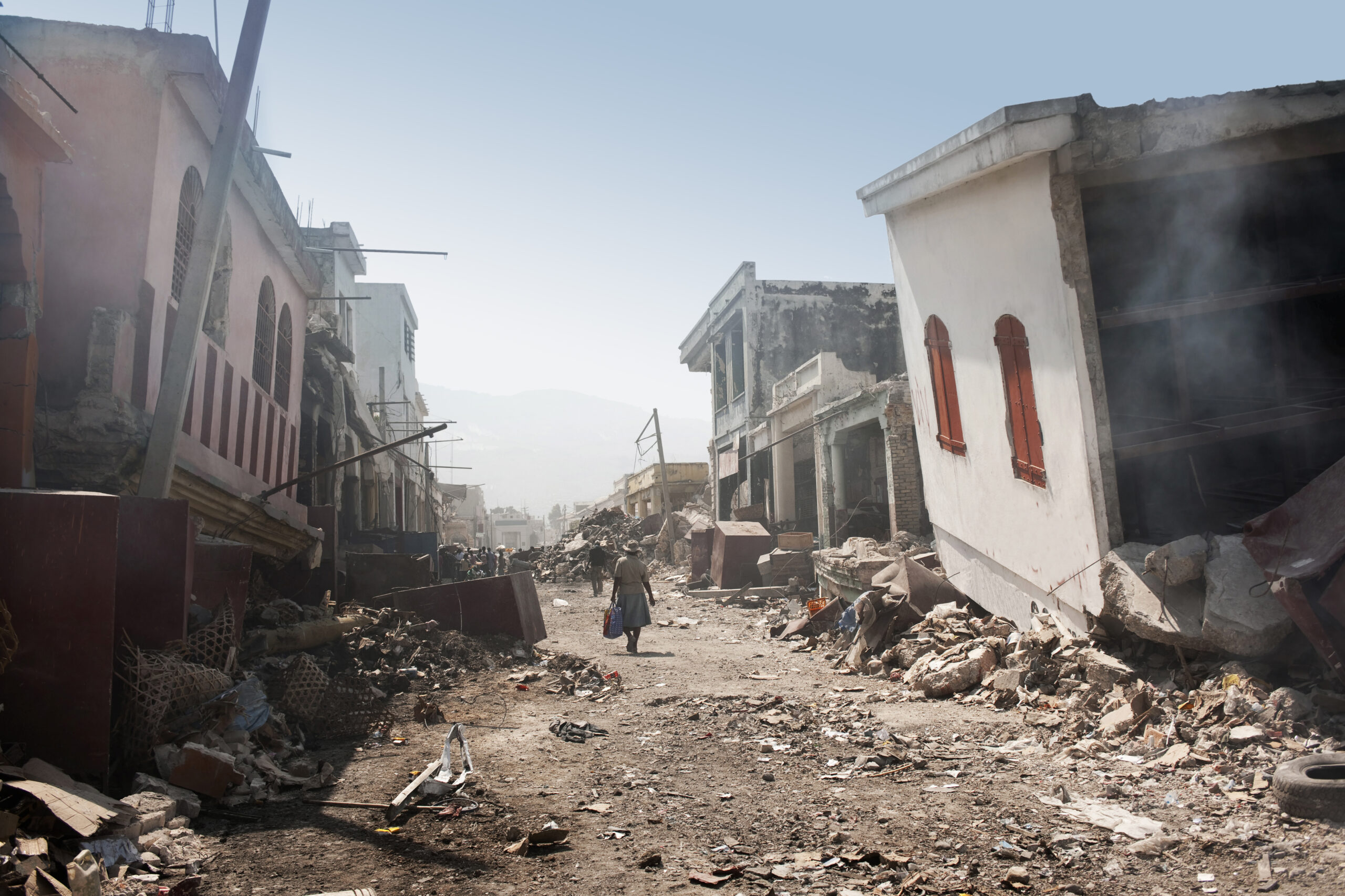
In response to the recent catastrophic earthquake in Haiti, Heart to Heart International CEO Kim Carroll and Director of Disaster Response Heather Lee shared with our team how the global humanitarian organization responds to disasters around the world and how philanthropy plays a critical role in disaster relief and response.
Below you’ll find the conversation.
Authored by: Ashley Hawkins, Content Specialist
Interview Highlights
The following exchange has been edited for length and clarity.
Greater Kansas City Community Foundation:
Let’s start with each of you. Could you share a little bit about your background, your current role with Heart to Heart International, and how you were drawn to the work of the mission of the organization?
Kim Carroll:
I’m Kim Carroll, and I’m the CEO of Heart to Heart International. I joined the organization five years ago. I joined Heart to Heart after a 30-year career in the pharmaceutical industry. I actually started with a Kansas City-based company called Marion Labs. After I retired from the pharmaceutical industry and was looking for something to do, I was familiar with Heart to Heart. Marion Labs was actually involved in the early work with Heart to Heart. So, I began as a volunteer. I was actually living on the East Coast and flying back and forth to Kansas City on volunteer projects, and then I decided to move back to Kansas City. I lived here in the 1980s and moved back, becoming the chief operating officer. And then moved on to that, which was five years ago, and I’ve been the CEO for about two and a half years now.
Heather Lee:
I’m Heather. I’ve been with Heart to Heart for about four years. Before that, I was in the army for 10 years. I knew that I wanted to get into the NGO world. I have a background in political science and went to a liberal arts, small university. And I had a lot of people that I looked up to who were humanitarians. And so, I knew that getting out of the army, that was the direction I wanted to take. I was going back to school for my master’s, and I Googled NGO near me. And Heart to Heart International popped up, and I loved their website, and I loved the work that they were doing. And so, I started out as a volunteer at the time. The only volunteer opportunity was like a front desk person. So I started out answering the phone and counting Hello Kitty Band-Aids for a few months.
Heather Lee:
And I just thought maybe I could learn through osmosis by sitting there. And luckily I was able to make some connections and get involved in a few more events so that when Hurricane Harvey and Maria hit, I deployed as a volunteer and then later came on board as staff. And so, I’ve been working with Heart to Heart ever since, so a bit of a roundabout way, but very few lucky things that could happen for me to get here for sure.
Kim Carroll:
Heather’s way too modest. Our volunteer screening process is now much more sophisticated than it was then. And so, we didn’t know that we had a retired black op captain and a company commander in Iraq, sitting there answering our phone so once, and she didn’t tell anybody. So, once we found that out, we redeployed her, as they say.
Greater Kansas City Community Foundation:
What a fascinating story. Heather, can you tell us a little bit more about your role right now, what you’re doing with the organization and what that looks like day to day?
Heather Lee:
Yeah, absolutely. I’m the director of disaster response. We deploy both domestically and internationally. A lot of that has to do with preparing ourselves internally to respond at a moment’s notice and also training our volunteer force to ensure that they’re responsible volunteers who are not only medically proficient but also understand many of those community principles. It’s really important for us to have a well-rounded volunteer force. In addition to that, we also have our ongoing operations in Haiti. That department also falls within my disaster response department.
Greater Kansas City Community Foundation:
As we enter a world with more technology and social media, how are you guys seeing disaster relief and aid evolve over time, particularly through the changing times and technology?
Kim Carroll:
Disaster response has changed a lot. If you just go back to the earthquake in 2010 in Haiti, there was a lot of good that was accomplished there, but there was a lot of bad. This led to a fundamental change in global humanitarian work, ultimately resulting in the World Health Organization (WHO) taking a leadership role in international responses. And so, if you look at how those responses happen now, if the country doesn’t ask for aid, the WHO does not bring teams in, and if the country does ask for aid under the WHO umbrella, you have to be part of the WHO system of classified responders. So that’s led to, unfortunately, when you have disasters, people are vulnerable, and the vulnerable can attract bad actors.
Kim Carroll:
And so you really have to maintain very, very high standards, doing background checks on people and making sure that they’re trained and making sure that you’re not doing more harm than good. So that’s evolved a great deal over time. And now with technology, there are quite a number of things that we’ve found to do, and I’ll let Heather speak to that. But telemedicine is one big piece of that.
Heather Lee:
Yeah. I think what we’ve seen, particularly in the last few years, is a significant professionalization of the humanitarian sector. I think that we’ll continue to see this trend, where it evolves from volunteers who mean well to an actual profession with set standards, and we are seeing those standards become more stringent. We’re obviously more connected with the health standards and sector, but that’s also going throughout other actors and agencies as well.
Heather Lee:
So it’s not just within the health cluster, but beyond that too, I think we’re also looking at a shift of focus into capacity building. So rather than external factors coming in and flooding a local system, it’s really more about also looking at a localized approach. So people who know their communities are best equipped to respond to a disaster. And I think that understanding is coming clearer every day as the disaster unfolds. So, it’s about empowering those local actors and coming in as a capacity builder rather than a supplanter. And I think we’ll continue to see that shift. And to Kim’s point, with technology, we can find creative ways to build local capacity, whether that be through virtual training, for example, which is a huge benefit. So, there are new and innovative ways in which we don’t have to be physically present, but we can still help.
Kim Carroll:
If you think about Haiti right now, Heart to Heart International’s patient medical staff works to treat patients within 36 hours. They’re local, they speak the language, they understand the culture. They’re trusted. They’ve been trained to the same standards as all of our international volunteers. And in fact, they actually deploy during Hurricane Maria in Puerto Rico because almost all of them speak Spanish as well as French and Creole. So, they’re far better equipped to respond in the current situation in Haiti than bringing in good doctors and nurses who are very, very well-trained, but who are from Vermont, Kansas, California, Texas. We’ve got some great people from all of those states, and they will respond with us, and we don’t have staff everywhere on the ground, so they are needed. But to this extent, we can train people ahead of time so that they are prepared. And then again, as Heather said, leverage technology, that’s really where this sector is moving.
Greater Kansas City Community Foundation:
You touched on this question a little earlier regarding the World Health Organization. It sounds like, with Heart to Heart International, that is the way you determine how and when you become engaged in a disaster, is that correct?
Kim Carroll:
Yeah. For anything international. Domestic, so if it’s a hurricane in New Orleans, then we work very differently. Heather and her team work with local organizations, BOAD, COAD and FEMA. And when those events happen, those clusters are all talking. They talk constantly anyway, and then they work with them on what’s needed. Oftentimes, we’ll send an advanced team first before we deploy a full team. That’s the domestic approach. They don’t happen very often in Kansas City, but thankfully, but when they do, we’re going to go check it out, no matter what.
Greater Kansas City Community Foundation:
When you respond, what determines how long you stay in a particular place? Is there something that initiated your withdrawal? Can you talk a little bit more about your timeline as you engage with different communities around the world that might find themselves in crisis?
Kim Carroll:
Yeah. I’ll give you an overview, and the answer is that it depends. We have fairly clear criteria for when and why we deploy. We have a matrix that Heather’s team has constructed and utilizes, but I’ll let her speak to the durations. Sometimes we know clearly. We just brought a team back from Papua New Guinea, and it was a WHO request for a six-week deployment. So, we knew that, but maybe you went to Honduras last fall, sometimes we’re there a while, and sometimes we come back quickly.
Heather Lee:
Yeah, it really definitely depends on the request, so if the government asks us to come in for two weeks, then we’ll honor that. And we’ll be in for two weeks. If we see a tremendous need that is still not being met, then we can extend that, but it’s always needs-driven and in concurrence and conjunction with the local health authorities. And that’s usually what our major driving factor is.
Kim Carroll:
And the harsh reality that we always deal with as a nonprofit is our financial capacity. So, some disasters get more financial resources than others. Disasters happen every day, all around the world. There are requests weekly, if not daily, from the WHO, but if we can’t fund them, we can’t deploy.
Heather Lee:
I think that that’s probably one of the most frustrating discoveries about this sector, which is that you’ll see tremendous need after a certain disaster or an ongoing crisis. You know that the need is tremendous, but because it’s not being talked about, or it’s not in that new cycle, those needs go unmet in a lot of instances, or you wouldn’t have the same type of resources to throw at it. And it really can be just dictated by what’s on the news at the time. And that’s a harsh reality, unfortunately.
Kim Carroll:
But it’s also something that, as an organization, we work on to have financial capacity, to be able to respond independently of the news cycle. So, we’re not there yet, but Heart to Heart International’s not there yet either. But we do have this part of our strategic plan in place, which includes the things we need to do to get to that point. But in the meantime, I have to say that the Kansas City community, especially, is incredibly generous. They really, really are. And so when we asked for help, the people in Kansas City step up always.
Heather Lee:
And I think our response to Papua New Guinea is a perfect example of that. I know that it’s not broadcast all over the news that Papua New Guinea needs assistance, but the reality is there. And so, we were able to fulfill that need and deploy because of the generosity of others, which enabled us to go to those places.
Greater Kansas City Community Foundation:
I have to agree with you. Our philanthropic community here in Kansas City is very generous, and we love working with them. We’ve talked a little bit about Haiti, but I’d like to take a bit of a deeper dive. I know that Heart to Heart International has been engaged in Haiti for quite some time, in the face of earthquakes and storms. It seems like one after the other, the country can’t seem to get a break. Can you talk to us a little bit about the most recent disasters that have occurred in Haiti and the current state of the country, and how Heart to Heart International is currently responding?
Kim Carroll:
I’ll start, and then Heather can really provide a lot of the details of what’s currently happening. As you said, Heart to Heart International has been operating in Haiti since 2010. We have Haitian staff. We have property and assets in the area. And in partnership with other organizations, the Church of the Resurrection, for one, and Highland Park United Methodist Church, based in Dallas. We actually operate clinics and programmatic work in Haiti year-round. That gave us the resources to respond quickly. Probably the last really big response that we had in the most recent one, prior to this, from a disaster standpoint in Haiti, was in 2016 after Hurricane Matthew. Heart to Heart International operated cholera treatment units in response to the outbreak of cholera that followed that particular hurricane. Cholera was not endemic to Haiti until 2010, when it was brought in by humanitarian aid workers, unfortunately.
Kim Carroll:
And so, when you have a storm, or, as in this particular earthquake, where the cisterns collapsed because they collect rainwater for their fresh water, we will see. It’s not; if we see cholera, we will likely see it in about seven to eight days. That was our last work there. But Heather can tell you everything that’s happening on the ground right now. She tracks them with her garment satellite technology. So, she knows exactly where they are, and she talks to them constantly throughout the day.
Heather Lee:
Yeah, we currently have a 10-person medical team deployed. That doesn’t include our drivers and support staff, but like 10 folks. They are split into two teams. So, they’re operating in the Lokasi region, which is the Southern portion. And then also a bit north of that as well.
Heather Lee:
They’re based out of a community called Baradères, but essentially, it’s surrounding the epicenter area, and our teams are operating as small mobile teams. There are facilities in some of the larger areas that can handle patients. But what we’re seeing is that there’s not a lot of presence of these smaller mobile teams. Yesterday, they had to MedEvac a woman, for example, whose house fell on her. She broke her hip and had been stuck for eight days. And we’re seeing lots of patients like that. These rural communities, which are difficult to access, are being left without any healthcare access. So, the mobility of our team is really critical. That’s kind of what they’ve got going on, but also in addition to that, they are seeing a lot of people; thousands and thousands of people are homeless because of all the damage to the homes.
Heather Lee:
So we’re kind of anticipating the next wave of disaster, in which we move past the broken bones and start looking into the aftereffects of folks not having proper shelter and food.
Kim Carroll:
And you have all of the traumatic injuries from an event like this and the long-term consequences, but life goes on, too. The rest of life doesn’t stop, so maybe you want to share the story about the young, now mother.
Heather Lee:
Yeah. In addition to folks having to deal with their homes being destroyed, to Kim’s point, people still have to live their lives, and people are still pregnant and having babies. And so, I think it was two mornings ago at our clinic site, a young mom came to the clinic site and was in active labor, and it was her first baby, and she was a bit at risk.
Heather Lee:
So our team had to drive her to the hospital, and she was able to deliver her baby safely at the hospital, no complications, thankfully. And she was actually able to go home that same day. So, her family came by to thank our medical team for the care that she received and for getting her to where she needed to be. But you think about having to deal with just the regular aftereffects of a disaster, but then also enduring big life events throughout that disaster. We were really grateful to be there and help.
Greater Kansas City Community Foundation:
You mentioned having folks on the ground, year-round in Haiti, do you think that helps you better navigate the geography, the culture, breaking down some of those barriers that might exist with organizations that are coming in new to the scene?
Kim Carroll:
Without a doubt. First of all, we were there, the team was there. So, it was just a matter of getting the phone call early Saturday morning here, but the work started with that team that morning, first to ensure they were all accounted for and then to get ready. And many of them were en route without even knowing whether their entire families were safe. So, they knew what they had to do, which was to use their training to get out and to help people. So, the ideal way to respond is to have that local capacity and local training. That’s an ideal world. We’re not there yet, but I think collectively the professionalization, as Heather says, of the sector, will move in that direction.
Heather Lee:
Yeah. I think a good story to drive that point home is that our team, on their first clinic day, came across a community that had a local tradition. They were providing traditional herbal remedies, and they were identifying that some of these herbal remedies weren’t going to fully treat the patient. There were some that were displaying signs of potential sepsis. So, the team was able to work side by side with the traditional doctor and say, ‘Okay, once you see them, can we also provide them some care as well?’ And they were welcomed, and they were able to do that side by side, so that the community still felt like their personal needs were being met. But also, we were able to make sure that their medical care was safe and effective. An outside team would not have been able to do that. We’re based in a mayor’s office, that’s where our team is based out of, because we’re already there and our medical directors are able to speak the same language and understand the same challenges. And that has been just critical to the success of our team.
Greater Kansas City Community Foundation:
What a beautiful story of partnering with the community to solve a problem. That’s wonderful. Along the same lines of partnerships, what other organizations are you working with on the ground? What other NGOs are you working with and who typically participates with you in these disaster relief and response efforts?
Kim Carroll:
So I’ll start on a macro basis. A lot of our work in Haiti is in partnership with the Church of the Resurrection in Overland Park and the United Methodist Church in Dallas. And so, we were all on the phone, immediately afterward, working on how to redeploy programs that they were doing. What do we need to keep going? Because there are parts of Haiti that are not impacted, and we need that work to continue. On the ground, Heather and her team develop partnerships throughout the year. And so, they may be in the health sector, or they may be in the wash sector or in food, so I’ll let her tell you a little bit more about some of that.
Heather Lee:
Yeah. I think keeping those connections is really critical because you want to be able to rely on folks that you trust during disasters.
Heather Lee:
So we work really closely with a lot of other health NGOs. I know Wes is coordinating and talking with Project Hope, for example, they’re a partner organization that we work with pretty frequently. For example, Samaritan’s Purse currently has a field hospital set up. So, our team lead is able to call out to them, send them a WhatsApp message and say, I’ve got like a couple of patients that need to be treated and referred here. So, I think it’s really important that we work together and collaborate. And that’s how we try to operate because not everybody can do everything well. And so, if we can lean on each other’s strengths, that’s really healthy and important.
Kim Carroll:
And we’re all members of organizations that support the sector, the INGO sector. And so, we meet regularly.
Kim Carroll:
I meet with CEOs from the sector every week on Zoom calls, which is one of the benefits of working in a largely virtual environment. I used to only see them a couple of times a year in Washington, DC, because that’s where most of them are headquartered. And now we either use WhatsApp daily or talk weekly, and we use Zoom weekly. So, there’s a lot of dialogue, and you have to build trust, just like you have to know that your own organization is trusted. You got to make sure that you’re partnering with organizations that share the same standards.
Greater Kansas City Community Foundation:
I want to shift gears a little bit and talk kind of from the philanthropy side of things. And I’d love to hear from you how philanthropy can be impactful in response to crisis. Obviously, monetary donations are wonderful and help you achieve your mission, but are there ways that philanthropy can be impactful beyond monetary contributions?
Kim Carroll:
Well, I think what you see with philanthropy, and we have, so this is not disaster specific, but one of the things that Heart to Heart International does is we’re a licensed wholesaler, a pharmaceutical wholesaler, and the pharmaceutical companies donate essential medicines. For conditions such as high blood pressure and diabetes, they donate antibiotics, insulin, pens, and devices that have value, and these items must meet quality standards. They’re not outdated; they’re just used devices. And so, we’re able to then, through a network of receiving organizations, make sure essential medicines are going to countries and to clinics that otherwise would not have access to quality health care. And that’s something that is, it’s a gift in kind. Now, gift in-kind is not for us, it’s not t-shirts or used items, but what it does is it enables, that is a form of philanthropy that it’s not cash, but it has tremendous value.
Kim Carroll:
And you also want to look at ways to, and the reality is things cost money to do, the programmatic work takes money, but the way people can make sure their philanthropy is most impactful is also through just as Heather talked about, the value of local emergency responders, making sure that we’re not donating food to a place that already has a functioning grocery store. Providing local grants to support people’s local economies. We don’t want to take jobs away from the local businesses. And so, thinking through that type of lens and philanthropy can be through volunteers and experts who give their time. One example here is that funding is required, but it’s much more than just that. One organization that we work with, BD, which is a pharmaceutical and medical device organization on the East Coast, funds a program that helps us install point-of-care laboratories in safety net clinics. Point-of-care labs are tools that physicians can use to make a diagnosis and a treatment decision in one visit.
Kim Carroll:
My doctor sends me to the lab, and I can go look at my online portal and find out what the results are. And then if I need to go back and see her, I can take an hour off work and go see her. If you’re an hourly worker, you can’t afford to lose a shift. You may not have transportation to get to that lab. Having point-of-care laboratories in clinics that serve under-researched communities is a huge benefit. BD does that with us through financial support, but they also provide volunteers who serve as volunteer laboratorians, helping to train the clinics on how to use the tools they have, so that the program can be sustained.
Kim Carroll:
So there are ways. It can be through volunteerism. That is a form of philanthropy. It can be through direct cash or making sure cash is going into those that are putting grants directly into the community, so that you’re not displacing business and revenue. And then the broader gift in-kind, and there are other types of gift in-kind in other sectors of philanthropy. Ours just happens to be healthcare. So, essential medicines are what we do, but there are other ways to provide that type of gift in kind.
Heather Lee:
Yeah, I’ll echo what Kim said in that I think informed philanthropy is really critical and key. It’s not just about providing money or time or resources, but it’s about providing them to the right place and being informed about whom you’re providing those funds to. It’s a much more technical thing than I’ve learned; being new to the sector, it’s not just about any good is good. And that’s not necessarily the case. In our workshop, we train our volunteers on mandatory principles and general ethics. And the first question I pose to them is How do you know if the organization you’re volunteering with is ethical? And so, I would think that if you’re thinking about donating, take the time to ask yourself that question; I think that goes a long way.
Greater Kansas City Community Foundation:
You kind of touched on this a little bit, Heather, earlier in your comments, but often, especially if you take a snapshot of today, we feel like there’s one disaster after another. And the endless train of media that we see. And so, if you looked at today, we’ve got wildfires, we’ve got the crisis in Afghanistan, we’ve got the situation in Haiti. So how does Heart to Heart combat this fatigue, this crisis fatigue, that you can often see in agencies and, how can donors have confidence in their ability to impact change when sometimes the need feels so overwhelming?
Heather Lee:
Well, I think first off, that’s a tremendous question. I’ll say this. Yes, there are many disasters, and we face them every day. I will also say, though, on the flip side of that, disasters bring out resilience, the strength in people, unlike anything else. And so, when you’re not on the ground, you’re not able to see the local community leader who decides to open up their church, for example, and works 18 hours a day to make sure that every single person has a hot meal. You miss those types of stories. And that happens in every single disaster. What you end up seeing is a group of people who care deeply about their community and really fight to make sure that everybody is taken care of. And it is so humbling to even observe that and see that.
Heather Lee:
And so I think that with every disaster that we see on the flip side of that story, there’s a whole other section of that side of that story that is really speaking to and demonstrating the deep resilience of the human spirit and that community element. And I do wish that was showcased a little bit more because it happens, and it has happened in every single disaster I’ve been to. I think for donors, as they’re trying to they do, just know that every little tiny thing that you do, does, it does help. And it may not help always from a macro perspective, from that micro perspective, though, it is tremendous. The nine people that our medical team e-vaced yesterday could have potentially died because of those wounds, and we were able to get them out of there. And so, from a CNN, like a large news level, that may seem kind of small, but for that community, it meant everything.
Heather Lee:
And those are the things that we kind of have to remember and focus on and not get swept up in.
Kim Carroll:
Yeah. And I’ll use one that’s not quite so raw at the moment. I’ll share an example of philanthropy and disaster response that, when spent correctly, leaves a community better and stronger than when you came in. It doesn’t necessarily bring them, solve everything, but done right, they are better off. And so, a couple of examples that we worked on in Puerto Rico, Heart to Heart International, of course, responded very quickly after Hurricane Maria. And we were there for quite a long time because the need was tremendous. But when it was time to exit, we had resources that we had focused on programs to make the communities we worked in stronger than they were before we arrived. And so one of them was up in a very remote part of the mountains, where that local community leader, Tito, is a tour de force.
Kim Carroll:
And he took a community that, as the crow flies, wasn’t that far from clinics, but as the roads curved around and collapsed constantly, it was impossible for people to get healthcare. He took an old coffee plantation and coffee roasting barn and turned it into a clinic. With partnerships from the pharmaceutical industry and the humanitarian aid sector, the clinic now has a pharmacy and dental capacity and is treating patients. Heart to Heart International funded community health workers who actually had a territory of that entire community. They know every person who lives there. They know every medicine that they take. And if there’s another event, they know exactly where to go and how to ensure everybody’s okay. And so, we also put in, there were towns that, if you don’t have clean water, you don’t have health. Towns where we worked with another partner, who’s not in the healthcare access sector, but to actually put in solar panels and wells so that they have access to clean water, even when the power grid is out, which is perpetual in Puerto Rico.
Kim Carroll:
That was a partnership we established. We engaged volunteers who received training. And so, it’s a small thing, but there are now two nonprofits that have trucks or four-wheel drive vehicles. So, for those communities, did we stop Puerto Rico from being impacted negatively again by an earthquake or hurricane because they have both? No but they’re better able to take care of themselves in their community. And that’s what good philanthropy looks like.
Greater Kansas City Community Foundation:
Is there anything that we haven’t discussed here today that you think would be important for our listeners to know about either the work of Heart to Heart International or the situation in Haiti?
Kim Carroll:
Yeah. I would like to reiterate how generous Kansas City has always been. And the one question we get is because people want to know how they can help, but they don’t necessarily know how or where to start. For us, the best thing is financial support for Heart to Heart International to do this work. They can then visit the Heart to Heart website at HeartToHeart.org.
If you are interested in using a charitable fund to support the work of disaster relief, let us know. You can always contact our team at info@growyourgiving.org to learn more.